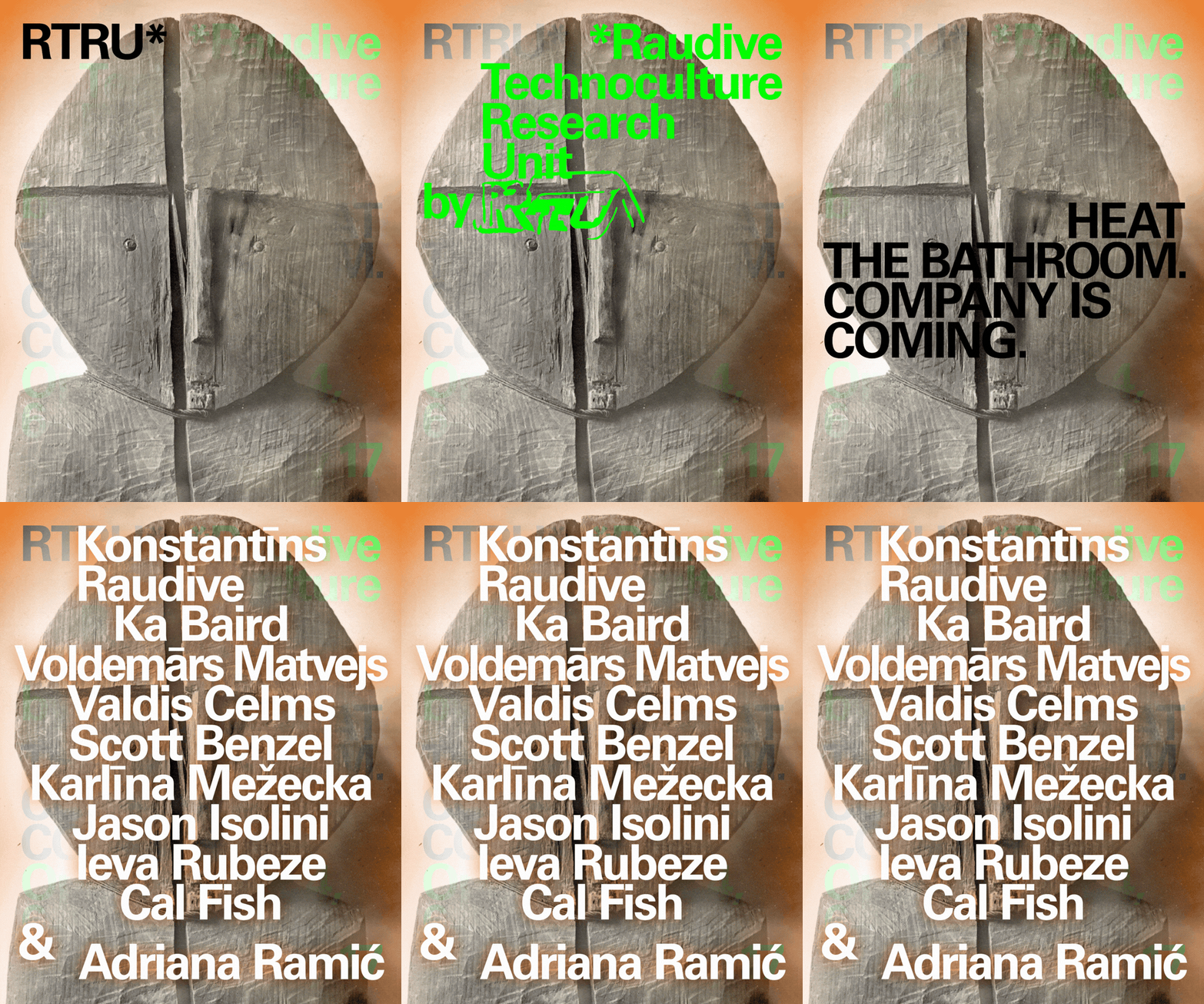
Group exhibition RTRU* at KAJE (NYC)
4.4.2026 - 17.5.2026
RTRU*
*Raudive Technoculture Research Unit
Ka Baird, Scott Benzel, Valdis Celms, Cal Fish, Jason Isolini, Voldemārs Matvejs, Karlīna Mežecka, Adriana Ramič, Konstantīns Raudive, Ieva Rubeze
Venue/Organized by: KAJE, 74 15th St., Brooklyn, NY 11215, NYC
RTRU: Zane Onckule, Elizaveta Shneyderman
Opening: April 4, 6-9 pm
Exhibition dates: April 5 – May 17
“Mammu, nāc ātrāk.”
(“Mother, come quickly.”)
RTRU presents RTRU* (Raudive Technoculture Research Unit), a group exhibition at KAJE that gathers around the figure of Konstantin Raudive (1909–1974), a Latvian writer, translator, philosopher, and parapsychological researcher known for his investigations into Electronic Voice Phenomena (EVP), the capture of disembodied voices onto magnetic tape. The exhibition title extends the name of the curatorial collective itself—RTRU (Riga Technoculture Research Unit), originally referencing the Cybernetic Culture Research Unit (CCRU) and the Baltic’s oldest technical university, Riga Technical University (RTU, est. 1862)—by substituting “Riga” with “Raudive,” aligning the exhibition’s subject with the collective’s own research framework.
In the psychic aftermath of postwar Europe, Raudive—formerly a student of Carl Jung—pioneered experimental recording techniques to collect what he believed were messages from the dead. Using radio static, blank tape, and improvised recording configurations, he claimed to document thousands of brief, compressed utterances: voices that appeared multilingual, fragmented, and resistant to stable interpretation. These recordings were assembled in his book Breakthrough (1971), where he catalogued and analyzed them through a method combining empirical observation with metaphysical conviction.
A polyglot, Raudive recorded voices compressed or hybridized across Latvian, German, Spanish, English, Italian, Swedish, Russian, and French, producing a fractured auditory field in which sounds hover between noise and recognition. He reported that many voices seemed to belong to those closest to him—most often his mother, who affectionately called him “Kostja”—yet the archive also features unsettling echoes of Churchill, Hitler, Stalin, and Mussolini, bringing intimate recollection into proximity with figures from twentieth-century history.
He proposed that the ability to discern voices in tape hiss was unevenly distributed, appearing predominantly among physicians, priests, military personnel, and teachers, framing listening itself as a trained and culturally conditioned practice. Statements—ranging from the mundane (“Heat the bathroom. Company is coming” / Bad heizen… Besuch kommt) to the obscure (“You belong probably to the cucumbers” / Du gehörst wahrscheinlich zu den Gurken)—and the first phrase Raudive believed he could clearly decipher—“that is right,” transcribed “pa-reizi-tā-būs”—were later said to have been present on earlier recordings all along, hinting at an archive whose meanings emerge retroactively through repeated listening, complicating the distinction between external transmission and internal perception.
The reception of Raudive’s work varies across cultural contexts. In Latvia, his legacy unfolds in two registers: an extensive literary catalogue of essays and translations, and the memory of a serious—if eccentric—intellectual whose investigations resonate with broader philosophical and spiritual traditions, a stance he occasionally framed through the concept of gara aristokrāts, the “aristocrat of spirit.” In the United States, Raudive’s recordings circulate primarily within paranormal subcultures—ghost hunters, speculative researchers, and late-night radio audiences.
Beyond these niches, the tapes circulate across cultural registers: hiss and buried voices appear in Christian metal as alleged satanic residues; The Smiths sample their spectral atmospherics; David Lynch explores related fascinations with disembodied transmission; William S. Burroughs’ tape cut-ups fragment and recombine recordings to reveal latent meaning; Mike Kelley adapts E.V .P. to his audio practice, valuing its blend of sonic effects, myth-making, interpretation, and spiritualist history and dubbing Raudive the “New King of Pop”. Labels such as Sub Rosa frame Raudive within experimental, industrial, and archival sound culture, where tape operates simultaneously as evidence, artifact, and aesthetic object moving between occult inquiry, avant-garde practice, and contemporary music.
RTRU* engages Raudive archive as material to be re-examined rather than resolved. Egg-carton acoustic structures shape the exhibition’s architecture, recalling improvised recording studios. Within this environment, the project leaves open whether Raudive should be understood as the inventor of a new perceptual apparatus or as a subject overtaken by auditory hallucination. If trauma marks a rupture in symbolic continuity, the recording apparatus appears as a prosthetic attempt to capture and stabilize what returns in distorted form. The exhibition, therefore, unfolds less as a linear narrative than as an exploded diagram in which voices, devices, testimonies, artworks, and documents are set into relation without being fully resolved. In this context, Raudive’s tape recorder operates both as an instrument and a reference point, producing fragments of speech whose speakers remain uncertain.
The works assembled in RTRU* span existing contemporary artworks, repurposed archival inserts, and new audio-tinted commissions by a cross-generational constellation of artists, living and deceased. Signals arrive fragmented, meanings remain provisional, and listening emerges as a deliberate and speculative labor rather than passive reception. Within such a field, messages rarely stay where they began: voices drift, contexts fracture, and what once circulated as metaphysical evidence reappears, without ceremony, inside the formal registers of sound art, archival playback, or even dance music. The persistent question is whether any residue of the original charge survives such migrations, or whether meaning, like tape hiss, simply conforms to the systems that reproduce it.
This question finds its echo in the inscription on Raudive’s own tombstone: “Nāves nav, ir tikai pārtapšana.” (“There is no death, only transformation.”). If that is the case, Raudive’s archive suggests a simple operational principle: signals do not disappear; they merely change formats. The question then becomes what continues to speak once the channel has been switched.
ABOUT RTRU
Established as the Riga Technoculture Research Unit in 2022 under the commission of Kim? Contemporary Art Centre in Riga, RTRU is a curatorial collective (Zane Onckule and Elizaveta Shneyderman) that develops exhibitions as open-ended systems of inquiry. Its projects bring together artworks and non-art objects within structured yet indeterminate frameworks, often organized around figures, concepts, or problematics that resist stable interpretation.
RTRU’s research engages the expanding field of technoculture and the circulation of technical images in contemporary art, approaching media not as autonomous innovations but as phenomena that emerge from, and feed back into, cultural conditions. Across its exhibitions, RTRU emphasizes juxtaposition, misalignment, and the redistribution of meaning across objects, contexts, and viewers. Rather than presenting a unified thesis, each project constructs a set of conditions through which multiple, and often conflicting, readings can emerge.
Additional curatorial support: State Culture Capital Foundation of Latvia
Curatorial assistant: Katrīna Jauģiete
Acknowledgements: Raudive Cultural Heritage Center, National Library of Latvia, Anna Vojevodska, Anna Dāve, artists.