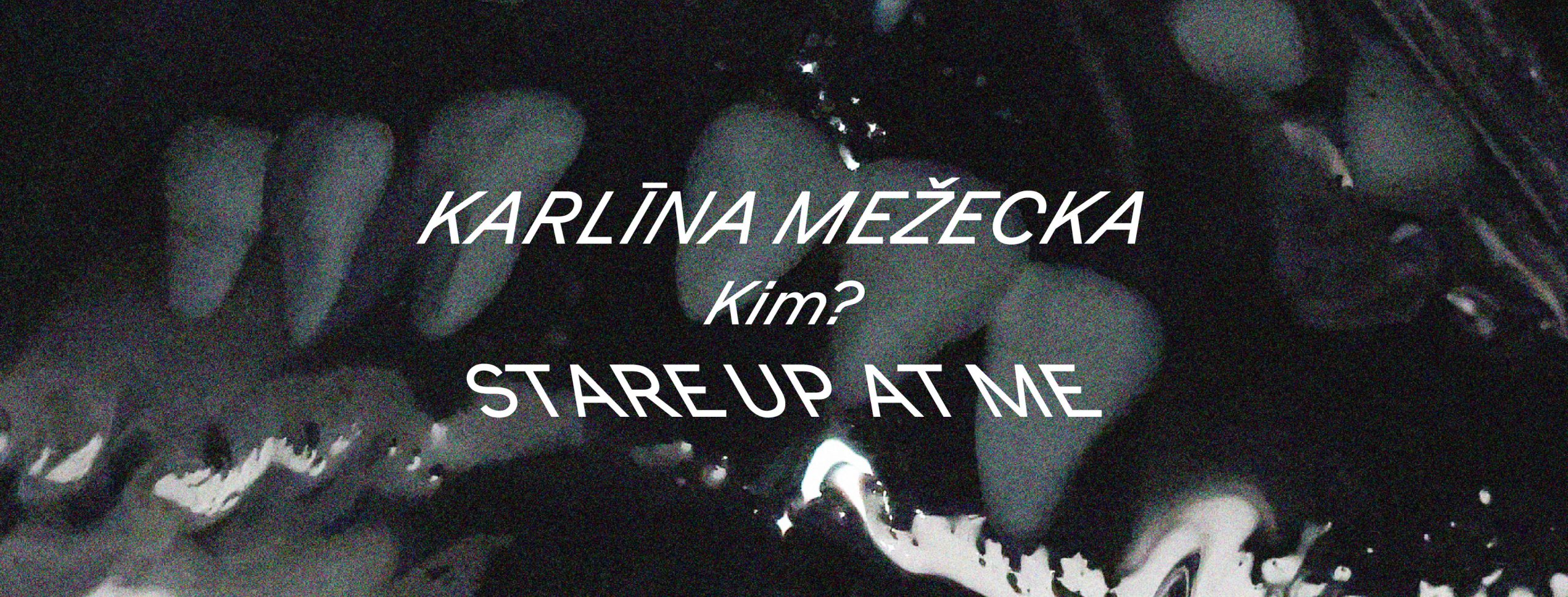
Karlīna Mežecka’s solo exhibition Stare Up At Me
19.6.2026 - 9.8.2026
Karlīna Mežecka
Stare Up At Me/“Veries manī”
solo exhibition
Opening: 18 June, 6–9 p.m.
Exhibition dates: 19 June–9 August, 2026
Venue: Kim? Contemporary Art Centre
Curated by Zane Onckule
Borrowing its title and dramaturgical undercurrent from Madonna’s “Don’t Tell Me” (2000) – a country-pop hallucination of suspended desire, emotional stasis and erotic ambivalence, punctuated by the lines “Tell the bed not to lay/Like the open mouth of a grave/Not to stare up at me/Like a calf down on its knees” – Karlīna Mežecka’s largest solo exhibition to date unfolds in four chapters: “Life”, “Death”, “Dominance” and the closing “Summary”. Through a series of new sculptural and installation-based works, Mežecka foregrounds bodies that appear as unstable figurations, suspended between surface and interior, between what is materially present and what remains imagined.
The unsettling image of a conjoined calf emerges as the exhibition’s central protagonist. In “Dominance”, it is elevated above the viewer, assuming a monumentality that never fully resolves into stability, as its fragility remains visible even at scale. Devotional iconography, infantilised objecthood, a sacrificial body, and failed monumentality converge within a single suspended presence. Its blank gaze holds the surrounding space in a sustained state of being addressed, circulating attention without closure and positioning the form simultaneously as object and projection surface.
The exhibition opens with the bed understood as a tidal condition: a horizontal zone of “Life,” in which intimacy, exhaustion, sexuality, illness, confession and silence accumulate like sediment along a shoreline, forming a slow basin of drift where bodily and mental states gather, dissolve and return. Resting on this surface is a loosely cast whale-like sculpture, its mass held between buoyancy and partial immersion, extending the spatial logic away from narrative progression and toward unresolved states of tension and pressure.
Alongside this material logic runs a visual language that the artist is particularly drawn to, which came into being under Soviet-period censorship, when sexuality and bodily intimacy were broadly suppressed, but in film, photography and literature they persisted in displaced form, for example, as rain on glass, submerged light or figures on the shoreline, so that desire was not represented directly but mediated through water, weather and reflective surfaces as a sanctioned mode of appearance.
From this subdued register, the exhibition turns to “Death” as a process of redistribution and material transformation. A luminous plinth, casting light upwards from the ground, frames ceramic works through visual references to reliquaries, deep-sea forms, archaeological fragments, and museum and clinical displays. Following the horizontal orientation of “Life” and the elevated viewpoint of “Dominance,” “Death” reconfigures perception through a downward gaze, positioning the viewer above the works. Light rises through and over their surfaces, blurring the distinctions between ceramic, mineral, epidermal and spectral qualities.
Regardless of the material, Mežecka’s works articulate a continuous negotiation between containment and breach. Ceramics, glass, metal and installations function as interdependent systems shaped by transfer, infiltration, and internal pressure. Her self-developed technique of blowing molten glass directly into handmade ceramic structures produces forms that appear swollen from within, as though breath, growth or intrusion had expanded them from their inner cavities outwards, rendering ornament and rupture inseparable on the same surface.
A continuous tripartite sound composition, tinted with dark ambient tones and punctuated by the noise of water impacts and the breaking of glass and metal, moves slowly through the galleries, establishing a shared sonic field that alters perception through duration. These sound cascades bind the rooms together as though they are held within the same pressure system, allowing time to thicken throughout the exhibition rather than advance in discrete steps.
The final space functions as a quiet conclusion: “Summary”, where vitrines gather dispersed photographic fragments into a still constellation of remnants in which physical encounters, bodily studies, skeletal forms, and sculptural residues coexist within a suspended field of attention. An atmosphere of continual transformation remains in circulation, carrying bodies between animality and sanctity, sensuality and estrangement, sleep and extinction, and onwards into forms yet to settle.
Karlīna Mežecka (b. 1995, Riga, Latvia) has been based in London since 2021. After completing a BA in Ceramics at the Art Academy of Latvia, she received an MA from the Royal College of Art, London. Recent solo and two-person exhibitions include Archive of Fragility at Kim? Contemporary Art Centre, Riga (2024); Security Patterns at Low Gallery, Riga (2022). Recent group exhibitions include RTRU* at KAJE, New York (2026); Dry Cleaning at Max Radford Gallery, London (2025); and Gradient Descent at Gossamer Fog, London (2024). Her works are held in the collections of Odunpazari Modern Museum (OMM), Eskişehir; VV Foundation, Riga; BTA Collection, Riga; and Roche Collection, Riga. Mežecka is the recipient of the Kim? Residency Award 2025 and undertook a residency at ISCP, New York, in September–October 2025.
Sound design by: Aleksejs Apolskis (VoidCells, Spoild)
Photography in collaboration with: Klaudija Avotiņa
Post-production: Ivo Pauls
Artist’s acknowledgements: Laura Mežecka, Rochester Square & Ewelina Bartkovska, Glasremis Studio
Supported by: The Ministry of Culture of the Republic of Latvia, The State Culture Capital Foundation, Riga City Council, KRASO, Kokmuiža, Media Port
Kim? Contemporary Art Centre and exhibition team:
Executive Director: Evita Goze
Programme Director: Zane Onckule
Communications Manager: Kristiāna Bērza
Sales Director: Dārta Purvlīce
Project manager: Betija Briede
Mediators: Poļina Gasparoviča, Emīlija Austra Lodiņa, Anna Annemarija Samsone, Alise Sedleniece, Linda Šterna
Technical team: Mārtiņš Aulmanis, Aldis Bušs, Andris Maračkovskis, Romāns Medvedevs
Latvian proofreading: Ilze Jansone
Latvian translation: Valts Miķelsons
English proofreading: Will Mawhood